Publications: Research of Hydrodynamic Separation For Stormwater Pollution Control
Hydrodynamic Separation For Stormwater Pollution Control
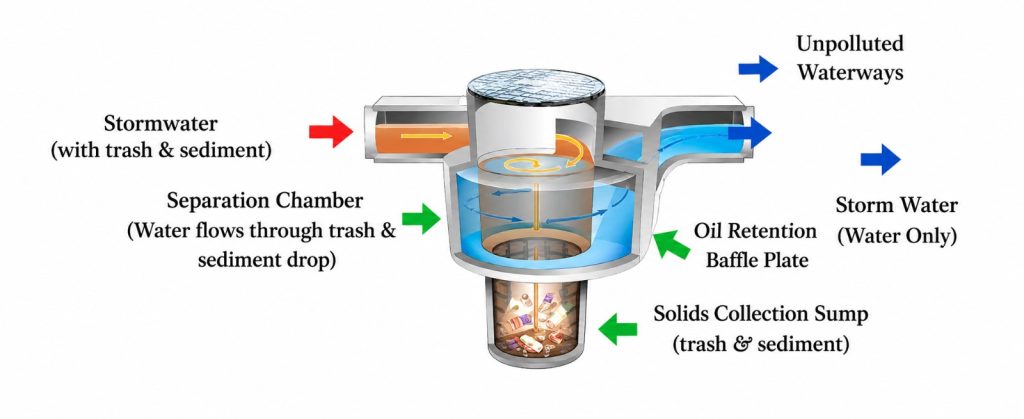
A collaborative research initiative between the University of Nottingham Malaysia, Ningbo University of Technology, and EcoClean Technology has evaluated a pilot-scale Hybrid Stormwater Treatment System (HSTS) engineered to manage polluted urban runoff under intense tropical conditions. Using the main page Continuous Deflective Separation (CDS) configuration as a foundational grey-infrastructure component, the multi-stage system routes real stormwater from an existing drainage network through a flow equalisation tank, a non-blocking CDS unit for gross pollutant and solid removal, a nature-based floating wetland featuring Chrysopogon zizanioides (vetiver grass) for biological uptake, and a final polishing phase utilizing biochar and natural zeolite filtration. Performance metrics from the continuous-flow study demonstrate highly efficient, progressive contaminant reduction across the treatment train, successfully mitigating 90% of Total Suspended Solids (TSS), 80% of Biochemical Oxygen Demand (BOD), 78% of nitrate ($NO_3^-$), 57% of both Total Dissolved Solids (TDS) and Chemical Oxygen Demand (COD), and 50% of oil and grease to elevate the treated effluent toward WQI Class 2B standards. Supported by Raspberry Pi hardware and Python-driven cloud telemetry for real-time monitoring and automated operational alerts, this research confirms that pairing hydrodynamic separation technology with nature-based solutions and IoT frameworks provides a resilient, data-driven, and scalable pathway for circular urban stormwater management.