Publications: Blue - Green Urban Stormwater Management
Blue - Green Urban Stormwater Management
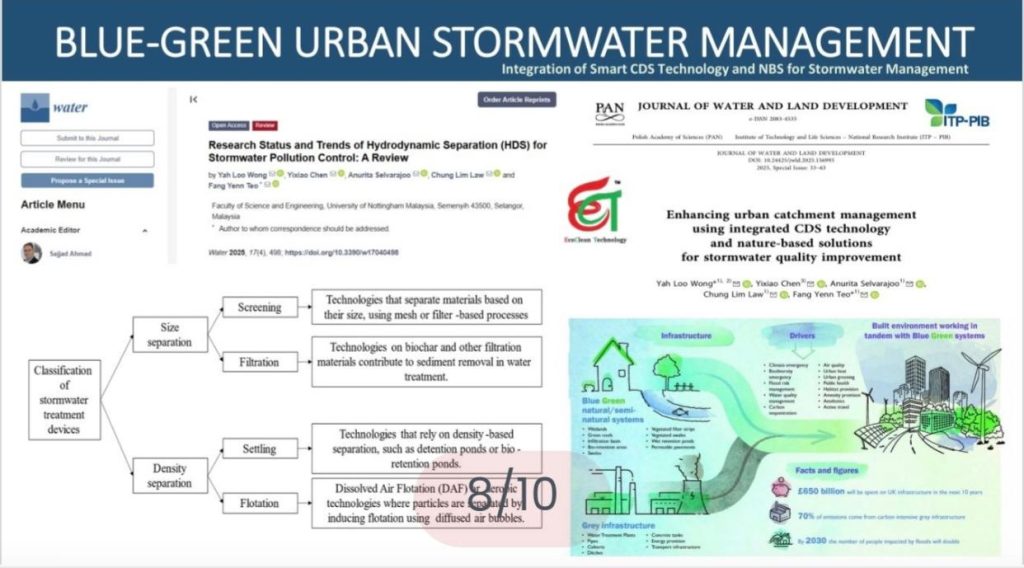
Together, these two studies by Wong, Chen, Selvarajoo, Law, and Teo build a complete picture of modern stormwater treatment: the first, a review published in Water (2025), surveys hydrodynamic separation technologies for stormwater pollution control, classifying treatment devices by how they separate pollutants either by size (screening and filtration) or density (settling and flotation) to map out where the field currently stands, the second, published in the PAN Journal of Water and Land Development (2025), puts that knowledge into practice by combining a vortex-driven hydrodynamic separator with nature-based solutions at a commercial urban site in Malaysia, layering a self-cleansing CDS unit with biochar and green zeolite filtration beds and a floating wetland planted with Vetiver grass, all monitored through an on-site IoT sensor network and the results were striking, with the CDS stage alone removing more than 99% of gross pollutants and over 95% of coarse sediment, while reducing total suspended solids by 85–90%, demonstrating that pairing engineered separation with natural, plant-based filtration can turn conventional urban drainage into a genuinely effective water-quality solution for rapidly developing tropical cities.